
E
Elliott Denman
Guest
Editor’s note: Elliott Denman sent this piece to me two days ago, and I promised that I would post! Elliott is our senior most senior writer, having written for American Athletics (1989-1994), American Track & Field (1994-2017), RunningNetwork (1996-present), and RunBlogRun (2006-present). An incredibly thoughtufl writer, Elliott Denman gives us a true sense of the history of our sport!
OLYMPIC 70-YEAR SALUTE
TO THE EIGHT MEN WHO BROUGHT HOME
UNMATCHED GLORY AT MELBOURNE
By ELLIOTT DENMAN
And now (so very sad to say, and as best I can tell) there are just eight of us.
Thane Baker, Charley Jenkins, Arnie Sowell, Don Bowden, John Bennett, Ira Davis, Ken Bantum…
And, oh yes, yours truly.
We’ve moved into the last week of November 2026. That means that the Games of the XVI Olympiad have been in our rear-view mirrors for – can you really believe it? – seven full decades.
Those precise dates: November 22 to December 8, 1956.
Most relevantly, and yes, 70 years later – the men’s basketball and field team that our Uncle Sam proudly dispatched to those Games is still considered the greatest this nation – or any nation – has sent to a modern Games.
Check it out/check it out. It’s one of our sport’s most overlooked factoids.
Even some of those Fifty-Sixers have been unaware how dominating they were.
These numbers tell you the story: fifteen (gold medals), Nine (silvers), Four (bronzes), four again (1-2-3 sweeps), Nine (Olympic records). Nine (gold medals) left for the rest of the universe.
These additional integers register importantly, too: One (first Games ever staged in the Southern Hemisphere.) Five (months past the heart of the American track schedule.) Ten thousand, three hundred at least (air miles from the East Coast of the USA).
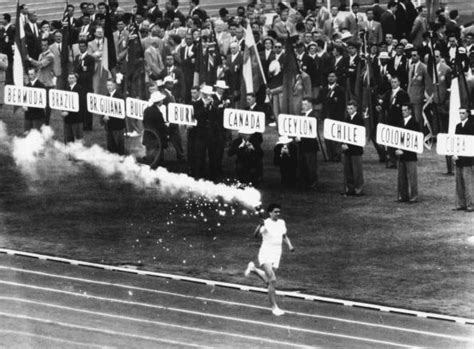
1956 Melbourne Olympics from MediaOlympics.com
Melbourne, Victoria, Australia was ready – even if much of the rest of the world wasn’t; the Suez Crisis was raging. The Hungarian Uprising (against its Soviet oppressors) was getting bloody. The Korea conflagration wasn’t far in recent memory.
But the show went on, and what a Games it was.
And everywhere you looked, as the Down Under Land of Oz headed into the heat of summer, those USA-clads were scorchingly brilliant, too.
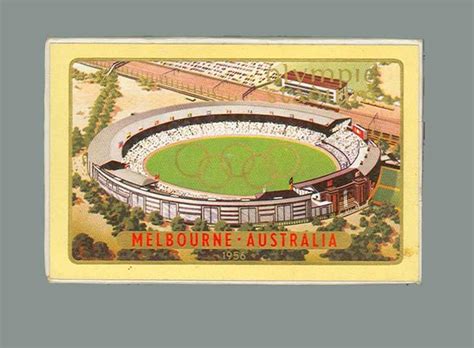
In almost all sports, but especially so at the Melbourne Cricket Ground, the ancient edifice (with a history dating back to 1856) that was transformed into a modern (for the era) athletics venue and seating over 100,000.
Sadly, the great majority of those who brought this glory back to the USA no longer walk among us. Such individual-events gold medalists as Bobby Morrow, Tom Courtney, Lee Calhoun, Glenn Davis, Charley Dumas, Rev. Bob Richards, Dr. Greg Bell, Parry O’BrO’Brien Oerter and Harold Connolly.
And the do-it-all decathlete Milt Campbell.
And relayists Leamon King, Ira Murchison, Jesse (J.W.) Mashburn and Lou Jones.
While they, too, were impacting the Melbourne Games, to a man the remaining eight were forever impacted by their Melbourne experience in return.
Kansas State’s (forever called Thane) Baker earned a silver medal (200-meter dash) at Helsinki in 1952, then returned to net gold (4×100), silver (100), and bronze (200) medals at Melbourne.
Just past his sophomore year at Villanova, Charley Jenkins won the 400 in a stunning upset, then another as third leg on the golden 4×400 quartet. (And he also cheered his Villanova pal Ron DelaDelany’s historic 1500-meter win for Ireland.)
When his Fordham University quartet set a world 4×800 relay record in 1954, Tom Courtney wasn’t considered the Bronx Rams’ runner. The honor belonged to teammate Bill Persischetty. By Melbourne time, though, Courtney was at the top of his game, edging Britain’s Sek Johnson in the final stride of the 800 final, then anchoring the winning 4×400 to strike double gold.
Heading into the homestretch of that frenzied Melbourne 800, Pittsburgh’s Arnie Sowell held the lead and nurtured his own golden dreams. But Courtney, Johnson and Norway’s Boysen surged ahead down the stretch, leaving Sowell fourth.
Don Bowden, then a University of California junior, wasn’t at his best Down Under. For very good reason – he was just getting over mononucleosis. But the experience paid off big time seven months later – his 3:58.7 second clocking was the first-ever sub-four-minute mile by an American.
John Bennett, a proud product of North Dakota, missed Olympic long jump gold by a slim four inches but took a solid silver back in Indiana.
Ira Davis surely ranked as one of America’s greatest ever triple jumpers, tripling his way to three Games – Melbourne, Rome (1960) and Tokyo (1964). His ’56 11th place – at age 20 – was a learning experience. His 4th place in ’60, just three quarters of an inch off the podium, displayed his true talents. He added a 9th in ’64.’
At 6-foot-6 and 235 pounds, Ken Bantum was surely no bantam. But he was a brilliant all-around thrower and versatile enough to help his Manhattan College Jaspers win the Penn Relays shuttle hurdles title. Teamed with 1-2 finishers Parry O’Brien and Bill Neider in the 1956 shot put, he had every hope of completing the sweep. But Jiri Skobla of Czechoslovakia squeezed past Queensite/NYC’NYC’stum for the bronze,
Well, as to that other guy, yours truly, he wound up 11th (and second of three Americans, behind Adolph Weinacker but ahead of Leo Sjogren) in his 50-kilometer (31.1-mile) walking tour of the Victorian capital. In brutal Down Under heat, New Zealander Read won it stunningly– in an event memorialized as a feat worthy of inclusion in famed Olympic historian Bud GreeGreenspan’s “Greatest Olympic Moments.”
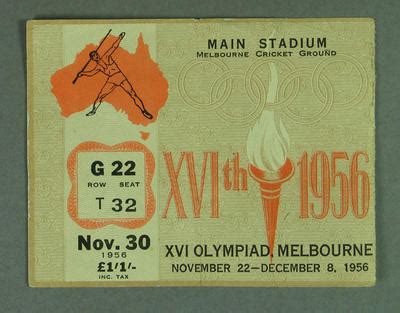
1956 ticket for Melbourne Olympics from Australia Sports Museum Collection
“Soviet Grigoriy Klimov (the world record-setter) and Britain’s Thompson (destined to win this longest of all Olympic tests at Rome four years later) were among those relegated to the Melbourne DNF list in the steam of Oz.
Very good news is that very good things have followed the Melbourne Eight in the ensuing seven decades.
As “The People Project, ” a biographical compendium, put it, “Thane Baker’s career is defined not only by elite international success but also by remarkable longevity, transitioning from a world-record-setting Olympian to a dominant Masters athlete and a respected official. Baker embodies dedication, humility, and service, extending his impact on the sport far beyond his competitive years.
Baker had a parallel professional life. He served for 30 years in the Air Force, rising to the rank of colonel through a combination of active and reserve duty. Concurrently, he built a long-term corporate career at Mobil Research and Development, where he worked for 39 years before retiring in 1992. “
“Nebraska resident Baker marked his 95th birthday on Nov. 4th and retains an active lifestyle – as a November 4th-goer and traveler –and continues in winning shape.
His daughter, Dr. Catherine Baker Nicholson, a former National 800-meter winner, is also an Olympic historian and scholar.
Recommended reading: her Dad’s photography, “Running in Borrowed Shoes.”
“Charley Jenkins would follow his famed mentor, James (Jumbo) Elliott, as Villanova head coach for years more, working for the U.S. Department of Education. And son Charles (Chip) Jenkins Jr. would join Dad in the Olympic archives – still an unprecedented feat – as a 4×400 relay team gold medalist at Barcelona in 1988.
Arnie Sowell ventured into the military sport of modern pentathlon after Melbourne and rose to lieutenant colonel in his Army career.
Don Bowden – whose Cal coach, Brutus Hamilton, was head coach of the 1952 USA Olympic team – would carve out a successful business career, often continuing his global travel ventures building tracks and other sports facilities.
John Bennett, a Marquette grad who once compiled a 31-meet long jump win streak, would go on to a retail business career in Wisconsin.
After coaching assignments – both track and football – at an array of NYC Metro Area schools – St. JohnJohn’s Merchant Marine Academy, Queens College, Andrew Jackson High School – Manhattan grad Ken Bantum would head west, and now calls Las Vegas his home.
Once, Ira Davis was best known as Wilt Chamberlain’s teammate (both basketball and track) at Philadelphia’s Overbrook High School. But this LaSalle University grad would do a lot more – he served as the LaSalle track coach. He became one of the most successful minority business owners in the Delaware Valley, owning development and moving companies.
That Denman guy, well, he kept right on walking (winning a pair of National titles in 1959, setting a U.S. record for the London-Brighton 52.5-mile classic, walking 33 NYC Marathons, etc.) and quite a bit more.
The 1956 NYU grad went on to a sports journalism career at The Asbury Park Press… and an array of other outlets. By the Atlanta Games of 1996, he was president of the Track and Field Writers of America.
Denman, now a West Long Branch, NJ resident, went on to cover 14 Olympic Games (a dozen Summer, two Winter), the first 18 editions of the World Outdoor Championships, over 50 editions of the Millrose Games and Penn Relays, and a whole lot more.
Across the lifetime travels, ventures, and achievements of these eight, it’s easy to say the doors that opened at Melbourne seven decades ago played key roles in them.
XXXXXXX
From the original 67-man roster of Team 56, Jesse “J.W.” Mahburn was the last to bid farewell.
The Oklahoma (then A&M/now State) alumnus was a two-time CAA 400 champion and two-time Olympian. He was there for the 4×400 at Helsinki but was not chosen to run it. But he took the baton from lead-off Lou Jones in the Melbourne final, ran a sizzling lap, and Jenkins and Courtney did the rest.
Tributes came in from all over Oklahoma, and many locales far beyond, at his passing on Nov. 13 at age 93.
After a torn Achilles tendon ended his track career, J.W. Mashburn Homes was founded in 1960, and the company built over 2,000 homes in south Oklahoma City and other areas. He also co‑founded J.W. Mashburn Development. He was active in local and national homebuilders’ associations, Oklahoma City public schools trusteeship, and community trusts.
xxxxxxx
Take Note: The women’s program at Melbourne consisted of a bare-bones nine events (100, 200, 80 hurdles, 4×100, high and long jumps, shot, discus, javelin). Contrasting with today’s card of 23. plus two mixed relays.
High jumper Mildred McDaniel was the lone USA gold medalist.
Willye White, then just 16, added a LJ silver medal in the first of her record five Olympic appearances; USA’s 4x100m relay team ran third,
Still with us are relay bronze medalist Margaret Matthews, shot putter Lois Testa, javelin thrower Karen Anderson-Oldham and javelin-discus doubler Margie Larney.
Resounding seven-decade cheers for these ’56 ’56ies, too !!!.