
L
Larry Eder
Guest
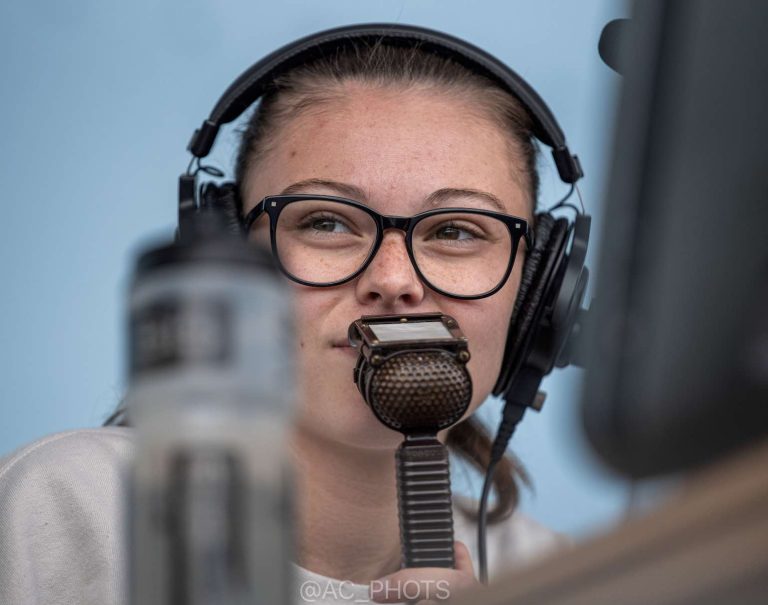
Editor’s Notes: Your favorite editor has been watching nearly every minute of the World Athletics Under 20 Championships, held in Eugene, August 5-9, 2026. She has been co-commentating with Rob Walker and Aussie Bruce McAveney.
Our readers asked me who she was, so I reached out to Maggie Durand, Director of Communications, with my question, and Maggie quickly responded, “Her name is Rosie Tinbergen; she is from the UK and part of our media academy in Tokyo.”
I must say, I have enjoyed Rosie Tinbergen working with Rob Walker and Bruce McAlveney. The near-constant presence of Rob and Rosie, the long morning sessions, and the insane Day 4 (nine hours) have been well received by our North American and European audience (1.1 million following on Day 2- Day 4, via Facebook, X, and IG RunblogRun).
RunBlogRun, 1. Rosie, how did you get involved in track and field?
Rosie Tinbergen: I got into track and field when I was eight. My mum is an avid runner, and so was my Gramps. When the opportunity arose to join a running club at my school, I took it, which led to my racing in my first cross-country. From there, I qualified to represent my region, so I went to my local running club. Once I joined Wreake and Soar Valley (a small club in the Midlands in the UK), I never looked back. I was training as much as I could and loving racing, eventually going on to win various amateur medals and become a steeplechaser with aspirations to compete at the international level. Although I never made it there, I still run and do triathlons. Athletics very quickly became my happy place, where I met some of my best friends, and it completely shaped my life. From my studies and choice of university to my now career.
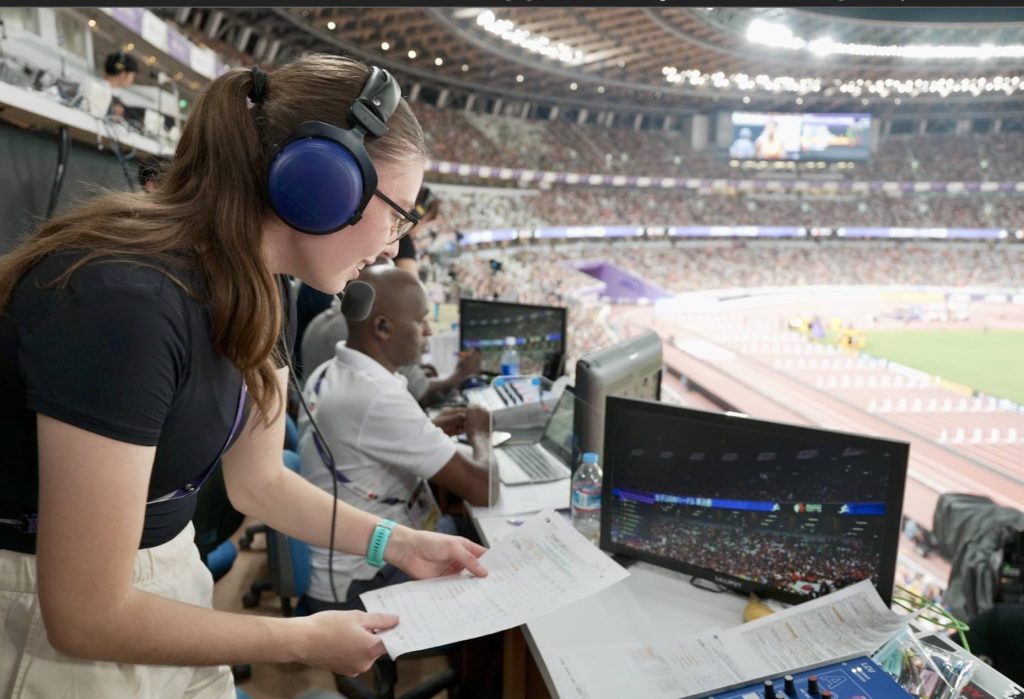
Rosie Tinbergen, Tokyo 2025 World Championships, photo courtesy of World Athletics
RunBlogRun, 2. How did you get involved in event announcing?
Rosie Tinbergen: My event announcing journey – whether it is TV commentary or in-stadium hosting duties began when I kept getting injured as a junior. It was hard not being able to compete with my friends. My coach, John Skevington, suggested I get on the mic for one of his events. That way, I was still involved and with my friends, all whilst trying something new. I put my all into it and became passionate about what I was doing. Gradually, people started hearing my voice, and invitations to work at more events came my way throughout my time at university. I completely fell in love with it, so I kept going. Eventually, it snowballed into bigger and bigger things – announcing at the finish line of the London Marathon, for example. Then the invitation to the World Athletics Media Academy last September was a massive surprise and an experience I will never forget.
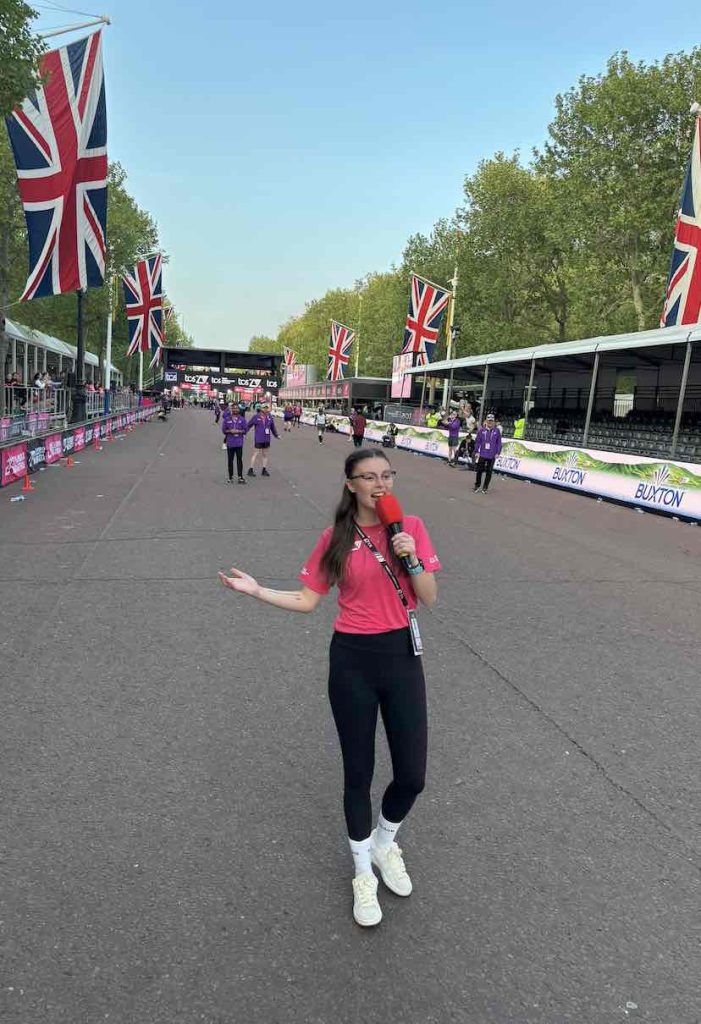
Rosie Tinbergen, London Marathon, photo by London Marathon Media
3. Do you get nervous before event announcing?
Rosie Tinbergen: I used to get very nervous, like when I was racing! Now, I’m starting to develop my own style as a broadcaster, and I feel much more at home – like this is the purest form of myself. I’ve become much more accepting of the fact that mistakes happen – it’s human, and we work at a fast pace at events. It’s inevitable. That acceptance has allowed me to be more comfortable on air and handle any mistakes better when they occur. With that, my nerves reduced a lot, and I like to think the quality of my broadcasting improved, but I’ll leave that up to others to decide! Ultimately, you will always have people that don’t enjoy your style, and you can’t control that. What I can control is being authentic, passionate, and myself on air, and having a good time. That’s when the best broadcasting happens.
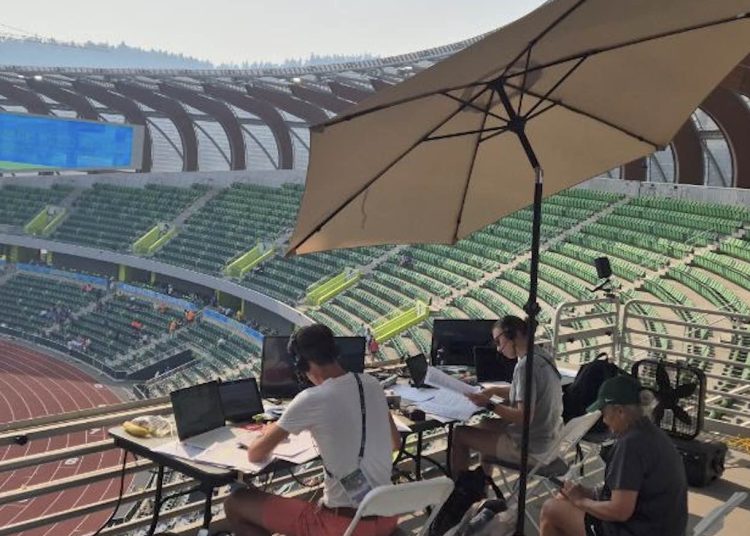
Rob Walker and Rosie Tinbergen, WA media team, Eugene WA U20 Champs, photo by World Athletics
RunBlogrun, 4. How long does it take to prepare for a day like the one you had on 5 August?
Rosie Tinbergen: Usually, we would spend a long while preparing for a day like that, at least a day, if not more. There’s research to do on the event itself, plus specifics to look into. Athlete performances, personal bests, nice anecdotes. When you get to a championship though, it’s quite different. You can be up late preparing the next day because start lists are only available on short notice, or up early for the same reason. Things become more last-minute and faster-paced- you have to be selective with your time and research. This is my first World Championship covering all the events (I was covering only the field at the World Indoors), and the only time we have stopped is to eat or sleep. It’s been a steep learning curve for me (in the best way), and the team has been great. We work together to make the load easier on each other.
At this championship, a normal day begins with arrival at the track as early as possible, with start lists already printed. A couple of hours of note-making before going live, and continuing to make notes as we go. Complete the morning session, grab lunch, and research until the evening begins. Then keep the notes and communication flowing as we progress through the night. It’s quick fire, but so much fun with good people around you.
RunBlogRun, 5. The sprints are quick developing; how do you prepare for those events?
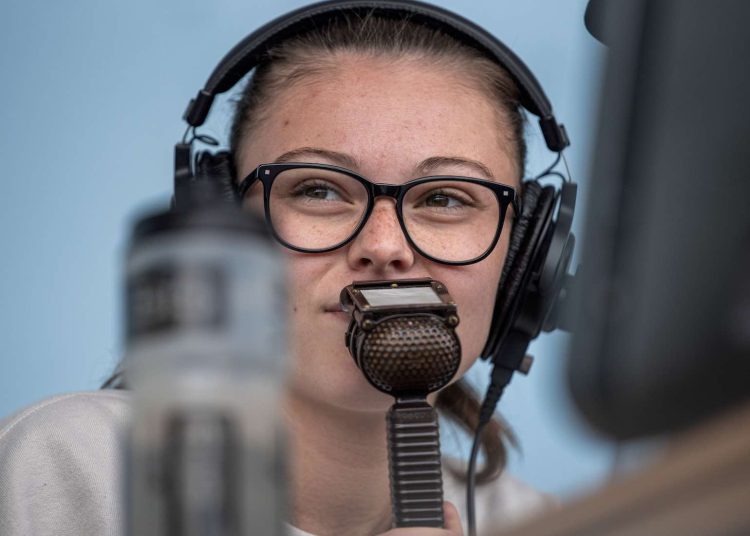
Rosie Tinbergen, World Athletics Media commentator, photo by World Athletics
Rosie Tinbergen: The sprints, it’s a case of making notes as you go. Make note of performances, those that go through, those that make a shock exit, and build from there. It’s so exciting to witness, so it’s important we make note of why so we can carry it forward when there’s so much going on. You want to be able to glance back at your notes and remember why it was a good race when you start prepping for the final.
RunBlogRun, 6. When you and Rob Walker do announcing, do you plan before which events to focus on?
Rosie Tinbergen: We absolutely do! Rob has been fantastic to work with. He’s taught me so much and really given me the opportunity to grow as a broadcaster. Before we start our research, we sit and decide who will take the lead on each event so that person knows what to look into. We then look into the potential of our own events, and are ready to support the other in theirs. After we come off air, we’ll usually chat about how incredible the event was, before deciding which events will be the blockbusters for the next day, and who will lead what for the next session.

Rob Walker, A commentator for the ages, photo by Deji Ogeyingbo
RunBlogRun, 7. I liked your announcing today; you let us see the events and didn’t overannounce. How do you plan your announcing?
Rosie Tinbergen: I’m glad you enjoyed it; that’s always so great to hear! Planning can vary somewhat, and it will do so more from person to person. If I’m opening the show, I’ll plan the introduction and what to include there – what’s coming up, for example, ones to watch, and highlights from the last session. From there, the extent of my planning is my research notes. Key things to include: important context and anecdotes. I try to think about what I would love a commentator to say about me, and go down that route. You could be talking about the biggest moment of someone’s life, so due diligence is important, but you don’t want to overpower it; sometimes the moment speaks for itself. I don’t like to script it too much – I think it’s important that the excitement and emotion are natural and free-flowing. That way the audience have a genuine feel for what’s happening in the stadium – it’s my job to convey that.
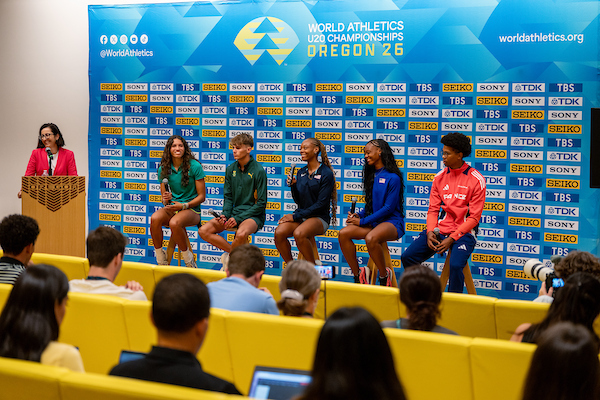
Eugene, Oregon, USA – Aug 04: Image of Leendert Koekemoer of team South Africa, Mael-Bephassou Lannurien of team France, Izobelle Louison-Roe of team Australia, Mia Maxwell and Mariah Maxwell of team United States at the press conference at the World Athletics U20 Championships Oregon 26, on August 4, 2026 in Eugene, Oregon. (Photo by Christel Saneh for World Athletics)
RunBlogRun, 8. What are the toughest events to announce?
Rosie Tinbergen: I think this can vary! My background is in distance running, so I can talk about this all day and always have been able to, but I had to do more research and teach myself in more depth about other parts of the sport. I think it really depends on your background.
RunBlogRun, 9. Do you watch social media while you are live at events?
Rosie Tinbergen: I keep a half-eye on interviews coming out of the mixed zone during events! This is when athletes are at their most emotional and adrenaline-fueled, and we can learn a lot about how they’re feeling here. Looking at short social media interviews can give us really great insights. It’s their first real chance to speak after their performance.
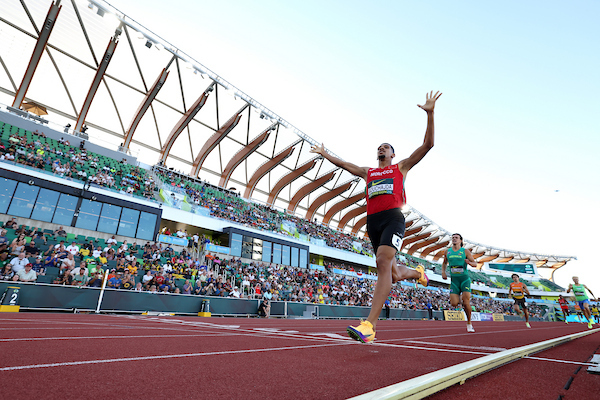
EUGENE, OREGON – AUGUST 08: Imad Bouchajda of Team Morocco celebrates a win in the Men’s 800m Finals during day four of the 2026 World Athletics U20 Championships at Hayward Field on August 08, 2026 in Eugene, Oregon. (Photo by Steph Chambers/WA/Getty Images for World Athletics)